CUSTOM LABELS FQA: 30 QUESTIONS ANSWERED BEFORE ORDERING
The 30 most frequently asked questions before customizing labels-here's what you need to know, hopefully it helps.
Q1: What is the minimum order quantity?
A: Digital printing has no MOQ limit-one roll is enough to start, ideal for sampling. Traditional flexographic printing typically requires a minimum of 10,000 pieces or 5,000 square meters, and involves plate-making fees. We recommend digital sampling first to confirm the effect, then switching to mass production for cost reduction.
Q2: Can the labels withstand freezer or high-temperature environments?
A: Ordinary coated paper will become brittle below zero degrees Celsius and discolour above eighty degrees. For extreme environments, synthetic paper or polyester film with weather-resistant adhesive must be used. Please inform us of your temperature range when placing your order, and we will recommend the appropriate material solution.
Q3: Is there a difference in adhesive for plastic bottles versus glass bottles?
A: Yes, there is a significant difference. Ordinary rubber-based adhesive works well on glass and metal, but polyethylene and polypropylene plastics are low-surface-energy materials and require specially formulated high-tack adhesives. We strongly recommend sending us your actual empty bottles for a stick test before mass production.
Q4: Roll form or sheet form?
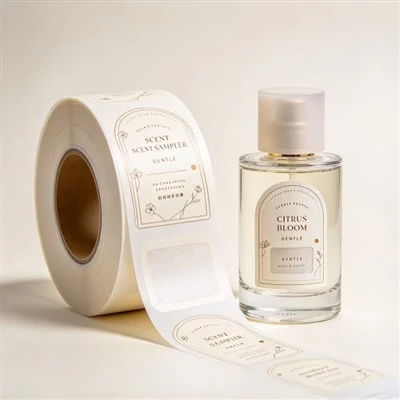
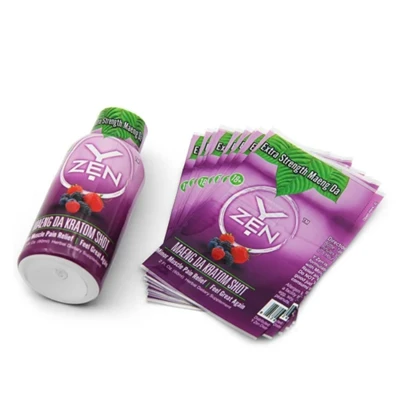
A: Automatic labelling machines require roll-form labels, typically with a core inner diameter of 76mm or 40mm. For manual hand application, sheet-form labels are more convenient. Please specify your labelling method when placing your order.
Q5: How long can the labels be stored?
A: Under room temperature, away from light, with constant temperature and humidity, the shelf life is one year. Beyond that, the adhesive may age, dry out, or bleed. We recommend purchasing in batches according to your actual usage to avoid overstocking.
Q6: Can you produce labels based on my sketches or physical samples?
A: Yes, we offer custom sampling services. You can send us a physical sample or provide a clear hand-drawn sketch with dimensions marked. We will measure and photograph the sample, and provide a digital mock-up for your confirmation free of charge. For complex patterns or gradients, we recommend providing electronic files for better accuracy; we can also assist in converting your sketches into standard design files for a small design fee.
Q7: Do you provide free design or file modification services?
A: We offer free basic file checking services, including verifying dimensions, bleed settings, resolution, and font outlining. If we spot any obvious issues, we will notify you promptly for revision. If you need full design work from scratch or complex modifications to existing files, a design fee will apply based on the workload, and this fee can be fully deducted from your subsequent bulk order.
Q8: Can extremely fine lines or small text be printed clearly?
A: For flexographic printing, the minimum line/text height should be no less than 0.3mm; for digital printing, no less than 0.2mm. For very small text, we recommend using solid background colour with reversed-out white text, which is much clearer than printing dark text over a gradient background.
Q9: Can you print variable data?
A: Yes, this is called digital variable printing. You provide an Excel data file, and we will print unique barcodes, QR codes, or serial numbers on each label. Please ensure sufficient white space (quiet zone) is reserved around barcodes and QR codes; otherwise, the scanner may not read them.
Q10: Will the printed colour look exactly the same as on my screen?
A: It cannot be 100% identical. Screens use RGB self-illuminating colour, while printing uses CMYK reflected colour. The most reliable approach is to provide a Pantone colour number or confirm against a physical colour proof we send you. Mass production will strictly follow that proof for colour matching.
Q11: How do I choose between lamination and varnishing?
A: Lamination is a physical film that provides excellent scratch resistance and waterproofing but makes the label stiffer, suitable for flat surfaces. Varnishing is a chemical coating that keeps the label soft and flexible, ideal for curved or irregular surfaces. Choose lamination for flat-surface labelling and varnishing for curved-surface labelling.
Q12: What are the limitations of hot foil stamping?
A: Fine lines may break during hot stamping, and large areas exceeding 50 square centimetres are prone to bubbling, requiring venting holes in the design. Hot stamping shows the most contrast on dark backgrounds such as black or navy blue, while the effect is less noticeable on light-coloured backgrounds.
Q13: Can the label have a hollow cut-out in the middle?
A: Yes, this can be achieved through partial or full-through die-cutting. However, the edge of the cut-out must be at least 3mm away from the outer border of the label, otherwise the narrow area is prone to tearing. Hollow designs require a custom die, which incurs additional tooling costs.
Q14: Should I add an easy-peel tear line on the backing paper?
A: We strongly recommend it. The cost is minimal, but it greatly improves the user's peeling experience. Adding a zigzag die-cut line or a side notch on the backing paper allows users to lift the label easily without using their fingernails.
Q15: How long will the label stay attached before it falls off?
A: This depends on the environment. Under normal indoor dry conditions, permanent labels can stay attached for 3 to 5 years. In outdoor sun-and-rain-exposed environments, adhesive strength typically lasts about 3 years. With frequent contact with oil or chemical solvents, the lifespan will be shorter. We can conduct accelerated aging tests on your actual product before mass production to simulate one, two, and three years of usage, giving you a reliable estimate.
Q16: Can you meet FDA or EU food-contact standards?
A: Yes, but this requires food-grade solvent-free adhesive and food-grade face materials, and we can provide corresponding FDA 21 CFR or EU 10/2011 test reports. Please note that compliance reports apply to the materials themselves; final legal compliance depends on your specific application scenario, and related responsibilities must be clearly defined in the contract.
Q17: What about removable adhesive versus tamper-evident labels?
A: For residue-free removal, choose removable adhesive. For tamper-evident security, use destructive adhesive combined with a brittle face material-once removed, the label will fracture or reveal a silver "VOID" pattern that cannot be restored. These two adhesive formulations are opposite in design, so you must clarify your requirement before ordering.
Q18: How long does sampling and bulk production take?
A: Digital samples are shipped within 48 hours. Bulk production normally takes 8 to 12 working days; projects involving complex processes such as hot stamping or hollow cut-outs require additional buffer time. Rush orders are available with an extra fee.
Q19: How are the labels packaged?
A: Roll-form labels are packaged with PE moisture-proof bags, strong paper cores, and five-layer corrugated cartons. Sheet-form labels are packaged with moisture-proof kraft paper and partitioned dividers to prevent adhesion between layers. Each carton is clearly marked with product name, quantity, batch number, and storage requirements.
Q20: What is the dimensional accuracy of the labels? Will they be crooked on the bottles?
A: Our die-cutting dimensional tolerance is controlled within plus or minus 0.5mm, which is the industry standard and meets the requirements of most automatic labelling machines. If your product demands extremely high positional accuracy, such as for medical needles or electronic components, we can tighten the tolerance to plus or minus 0.2mm, but this requires higher-precision tooling and increased inspection frequency, which will incur additional costs. Crooked application is more dependent on the labelling machine's positioning system; we can provide auxiliary registration mark designs to help calibrate your equipment.
Q21: What should I do if I have issues with the received goods?
A: Keep the unopened cartons intact and send back a three-metre sample. If the colour difference ΔE ≥ 3 or die-cutting offset exceeds ±1mm, we will reprint unconditionally and bear the round-trip shipping costs. White edges caused by insufficient bleed in your file are not considered a quality defect.
Q22: Do I need to pay the plate-making fee again for a reorder?
A: No. The plate-making fee is a one-time charge for the first order. As long as your label size, material, and process remain unchanged for subsequent reorders, we retain your printing cylinders and die-cutting tools, and you will only be charged for printing and materials on each reorder. However, if the interval exceeds two years or we have upgraded our equipment in between, new plates may be required, and we will inform you in advance, charging only the cost price.
Q23: How can I get the most cost-effective pricing?
A: Reduce the number of spot colours and use CMYK four-colour printing instead; unify multiple label designs to the same width so they can be ganged on one plate to share plate costs; and eliminate unnecessary lamination. Combining these three strategies can save approximately 30% of the total cost.
Q24: What are the payment terms?
A: For the first order, a 50% deposit is required upfront, with the balance paid before shipment. Established customers with a good track record may apply for monthly net-30 payment terms. We accept corporate bank transfers, WeChat Pay, and Alipay.
Q25: How do you achieve a no-label look on glass bottles?
A: Use BOPP clear film as the face material, and completely hollow out the background (no white ink printed). Print the coloured graphics and text directly on the clear film. When applied to a clear glass bottle, only the pattern is visible, and the rest is completely transparent-creating the visual effect of being printed directly on the bottle.
Q26: Can I write on the label surface with a ballpoint pen or marker for date/batch numbers?
A: Yes, but it depends on the surface treatment. Glossy laminated labels are smooth-ordinary ballpoint pens won't write on them; you need an oil-based marker and allow a few seconds to dry. Matte laminated labels have a slightly textured surface and accept both ballpoint pens and markers well with quick drying. Uncoated paper labels have the best ink absorption and accept any pen, but they are not waterproof-handwriting will smudge upon contact with water. If you have handwriting requirements, we recommend the matte lamination option, which is both writable and waterproof.
Q27: Can labels be made in round shapes? Are custom shapes extra?
A: Yes, our die-cutting process supports any shape, including circles, ovals, hearts, and custom irregular contours. Standard shapes like circles and rectangles generally incur no extra charge, but complex irregular contours require a custom die, which involves a one-time tooling fee ranging from a few hundred to over a thousand yuan depending on complexity. Once the die is made, it belongs to you, and subsequent reorders of the same shape will not incur additional die fees.
Q28: Can you provide labelling machine setup guidance?
A: Yes, we provide a labelling parameter reference sheet covering gap tolerances, tension range, and peel-plate angle. If your machine frequently experiences missing labels or double feeding, we can produce specially trimmed rolls with tighter tolerances, and can assist in coordinating with the equipment manufacturer if needed.
Q29: Will colour remain consistent on reorders?
A: For digital printing, batch-to-batch colour difference is ΔE < 2. For traditional printing, we retain the ink formulation records and retained colour samples from the first batch. For reorders, we will first print a sample and adjust until the colour difference ΔE ≤ 1 compared to the retained sample, then proceed to mass production-achieving visually indistinguishable consistency.
Q30: What should I do if bubbles appear when applying the label?
A: Before application, wipe the surface with isopropyl alcohol to remove oil and dirt, and ensure the application environment temperature is between 20°C and 25°C, which is the optimal activation temperature for the adhesive. For further protection, you may choose labels with a built-in micro-channel air-vent structure-a simple scrape with a squeegee will expel all trapped air bubbles.
If you have any other questions, feel free to contact us-we will respond promptly.
Email:rita@print-unions.com
TEL:+8615260221651