

When choosing a label material, appearance is only one part of the decision. The label also needs to match the product surface, storage conditions, moisture exposure, expected durability, and overall packaging design. Two materials that are often considered for durable product labeling are BOPP labels and vinyl labels.
Although both are plastic-based film labels and can provide better resistance to moisture than many paper labels, BOPP vs vinyl labels is not simply a question of which material is stronger. They have different characteristics and can perform better in different applications.
For brands developing food, beverage, cosmetic, household, outdoor, or specialty products, understanding the difference between BOPP and vinyl labels can make it easier to select the right material before production. This guide compares their characteristics, similarities, differences, applications, and important factors to consider when ordering custom labels.

What Are BOPP Labels?
BOPP labels are made from biaxially oriented polypropylene film. BOPP is a type of polypropylene that has been stretched in two directions during manufacturing, creating a film with useful strength, dimensional stability, and resistance properties.
In label applications, BOPP is available in clear, white, matte, and other constructions. Clear BOPP can create a "no-label" appearance when applied correctly, while white or specialty BOPP can provide a strong background for printed graphics. Avery Dennison, for example, describes BOPP film solutions for applications including food, beverage, personal care, and other packaging uses.
One of the major reasons brands choose BOPP labels is their resistance to moisture, tearing, and everyday handling. Some BOPP constructions are also designed for applications involving oils, chemicals, abrasion, or demanding environmental conditions. However, actual performance depends on the complete label construction, including the facestock, adhesive, coating, and application surface.
This makes BOPP a practical material for many consumer product labels where the package needs to maintain a clean appearance while facing moisture or frequent handling.

What Are Vinyl Labels?
Vinyl labels are labels made with vinyl film, commonly referring to PVC-based film in pressure-sensitive label applications. Vinyl is known for flexibility, conformability, and resistance to outdoor and demanding environmental conditions when the appropriate grade and adhesive are selected.
Compared with some more rigid film materials, vinyl can be useful when a label needs to follow curved, irregular, or slightly flexible surfaces. It is often considered for applications where flexibility and durability are important.
Vinyl labels can be produced in different finishes and colors, including white, clear, matte, and glossy versions. They can also be combined with protective laminates or coatings when additional resistance is required.
However, "vinyl" covers a range of constructions, so performance should not be judged from the material name alone. The exact film thickness, adhesive, ink system, laminate, and intended environment can significantly affect the final result.

What Do BOPP and Vinyl Labels Have in Common?
The similarities between BOPP labels and vinyl labels are one reason buyers sometimes have difficulty choosing between them.
Both are film-based materials rather than conventional paper facestocks. This means they can offer advantages when a product needs more resistance to moisture or handling than a basic paper label can provide.
Both materials can also be customized in terms of:
Size and shape
White or clear appearance
Matte or glossy finish
Printed colors
Die-cut shapes
Surface effects
Adhesive selection
Protective coatings or laminates
Both can also be used for custom printed labels where branding, product information, barcodes, and decorative graphics need to be printed directly onto the label.
However, similar does not mean identical. Their differences become more important when the product has specific environmental or application requirements.
BOPP vs Vinyl Labels: What Are the Main Differences?
The biggest differences between BOPP and vinyl labels are related to flexibility, appearance, application requirements, durability, and the type of packaging they are intended for.
Material Structure and Feel
BOPP is a polypropylene film that generally provides a clean, smooth, modern appearance. Depending on the construction, it can be clear, white, matte, or specially finished.
Vinyl is typically more flexible and can conform well to curved or irregular surfaces. This characteristic can make vinyl useful for applications where the label needs to follow the shape of the product closely.
Neither material is automatically better in every situation. The better choice depends on the container and the conditions the label will encounter.
Moisture Resistance
Both materials can be used in applications where moisture resistance is important, but the complete label construction matters.
BOPP is widely used for beverage, food, personal care, and other packaging applications where water resistance is needed. Avery Dennison's BOPP materials include constructions specifically described as water-resistant and resistant to environmental factors.
Vinyl can also perform well in wet or outdoor environments, especially when paired with a suitable adhesive and protective finish.
For a product that will be exposed to water, condensation, or humidity, it is better to evaluate the complete material-and-adhesive combination rather than choosing based only on the film name.
Brands can also review 【waterproof labels】 when comparing different constructions for wet environments.
Flexibility and Conformability
This is an important area where vinyl may have an advantage.
Vinyl is flexible and can conform well to many curved or irregular surfaces. This can be useful for containers, equipment, tools, outdoor products, or other products where a rigid-looking film may not follow the surface as easily.
BOPP is also available in different constructions and can work on curved packaging, particularly common consumer containers. However, the exact BOPP grade and adhesive need to be matched to the package.
For bottles with strong curves, squeezable containers, or unusual surfaces, suppliers should evaluate the actual packaging before confirming the material.
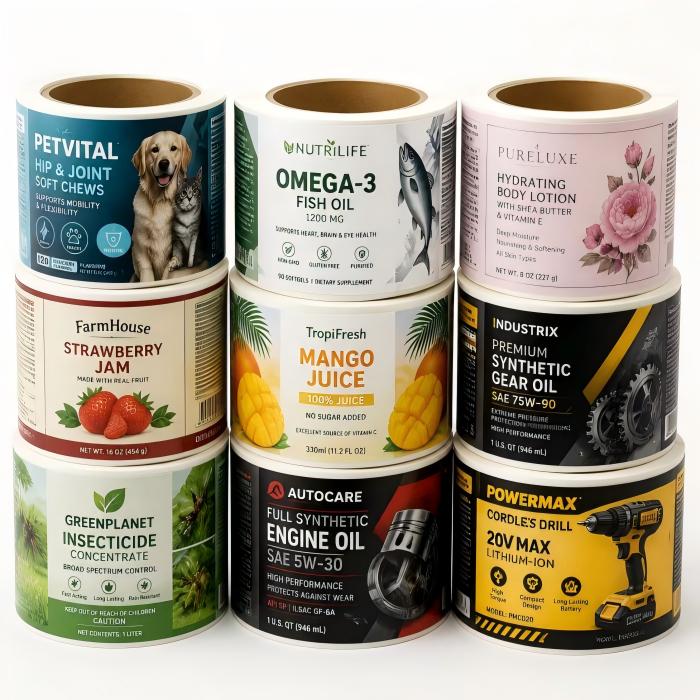
Appearance
BOPP is popular in consumer packaging partly because it can provide a clean and high-quality appearance.
Clear BOPP can be used to create a transparent label effect, while white BOPP provides an opaque printable surface. Specialty BOPP films can also create metallic, pearlescent, or other visual effects. Avery Dennison notes that its BOPP portfolio includes clear, white, cavitated white, and metallized options for different visual requirements.
Vinyl is also available in clear, white, matte, glossy, and other finishes. Its flexibility makes it particularly useful when the label needs to visually and physically follow the shape of the product.
For brands focused heavily on shelf appearance, the final choice should consider not only the film but also printing, coating, finishing, adhesive, and the color of the container underneath the label.
When Should You Choose BOPP Labels?
BOPP labels are often a strong option when a brand wants a clean packaging appearance combined with moisture resistance and good everyday durability.
Typical applications include:
Food and beverage: BOPP can be suitable for bottles, jars, containers, and other packaging where moisture or condensation may be present.
Cosmetics and personal care: BOPP can provide a smooth, modern appearance and is available in clear, white, and specialty constructions. Avery Dennison lists BOPP solutions for health, beauty, food, beverage, and personal care applications.
Coffee and specialty food: Clear or white BOPP can provide a clean appearance while offering resistance to everyday handling.
Household products: For products that may encounter moisture or light chemical exposure, an appropriate BOPP construction can provide useful resistance.
Products requiring a "no-label" appearance: Clear BOPP is commonly used when brands want the printed design to appear directly on the container surface.
If your packaging is primarily consumer-focused and you want a combination of visual quality, moisture resistance, and a relatively clean film appearance, BOPP is worth considering.

When Should You Choose Vinyl Labels?
Vinyl labels may be more appropriate when flexibility, conformability, and demanding environmental conditions are key requirements.
They can be considered for:
Outdoor products
Equipment and tools
Promotional stickers
Curved or irregular surfaces
Products requiring flexible labels
Applications where abrasion or environmental exposure is a concern
Decorative or specialty stickers
For outdoor applications, however, material selection should not be based on the film alone. Testing should consider the actual substrate, adhesive, protective coating, temperature, humidity, UV exposure, and other environmental factors. Avery Dennison recommends evaluating the complete label construction under the intended conditions because label performance can vary significantly depending on the combination of materials.
This is particularly important when a label needs to remain outdoors for an extended period.
BOPP vs Vinyl: Which One Is Better for Different Products?
There is no universal winner between the two materials. A better approach is to start with the product's actual requirements.
| Application | BOPP | Vinyl |
|---|---|---|
| Beverage bottles | Excellent option | Possible |
| Food packaging | Excellent option | Possible |
| Cosmetic bottles | Excellent option | Possible |
| Personal care products | Excellent option | Possible |
| Clear "no-label" look | Excellent option | Available |
| Curved surfaces | Suitable with correct construction | Often useful |
| Outdoor applications | Depends on specification | Often considered |
| Flexible surfaces | Depends on grade | Often suitable |
| Moisture exposure | Strong option | Strong option |
| Premium consumer packaging | Strong option | Suitable |
This comparison should be treated as a starting point rather than a universal material specification. The actual result depends on the specific film grade, adhesive, printing method, surface, and environmental conditions.
How to Choose Between BOPP and Vinyl Labels
If you are still unsure about BOPP vs vinyl labels, ask five practical questions before placing an order.
1. What is the product?
A beverage, cosmetic bottle, outdoor tool, candle, or industrial product may require completely different label characteristics.
2. What is the packaging surface?
Consider whether the surface is glass, plastic, metal, cardboard, smooth, textured, flat, or curved.
3. Will the label contact water or chemicals?
Moisture, oils, cleaning products, and other substances can affect both adhesion and print durability.
4. Does the label need to flex?
If the packaging is flexible or has unusual curves, conformability becomes more important.
5. How long does the label need to perform?
A short-term promotional sticker and a label expected to remain outdoors for years should not be specified in the same way.
For demanding applications, testing the actual label construction on the production-intended packaging is the safest approach. Industry guidance notes that factors such as temperature, moisture, product lifetime, substrate, printing technology, and aesthetics can all influence the appropriate label solution.
Common Mistakes When Choosing BOPP or Vinyl
One common mistake is assuming that all film labels have the same performance. They do not. Film type is only one component of the finished label.
Another mistake is choosing a material based only on appearance. A label may look excellent in a sample room but perform poorly if it is exposed to moisture, heat, chemicals, abrasion, or an unsuitable surface.
Some buyers also overlook the adhesive. Even a durable film can fail if the adhesive is not suitable for the container or application conditions.
It is also important not to assume that "waterproof" automatically means "suitable for outdoor use." Outdoor durability may involve UV exposure, temperature changes, humidity, abrasion, and long-term adhesion. Different tests may be required to evaluate these factors.
For brands that are comparing materials for a new product, it is often better to explain the actual application to the label manufacturer instead of simply requesting "BOPP" or "vinyl."

Can BOPP and Vinyl Labels Be Customized?
Yes. Both materials can support a wide range of label designs and finishing options.
Depending on the material and printing system, customization can include CMYK printing, Pantone colors, white ink, glossy or matte finishes, metallic effects, special shapes, and other decorative treatments.
For premium packaging, brands may combine film labels with foil stamping, embossing, or other effects. For minimalist packaging, a clear film with carefully controlled printing can create a cleaner appearance.
You can also explore 【custom product labels】 when comparing different combinations of material, printing, shape, and finishing.
For businesses that need multiple packaging components, film labels can also be coordinated with 【custom packaging labels】, boxes, bags, hang tags, and other printed materials to create a consistent brand identity.
FAQ
Are BOPP labels the same as vinyl labels?
No. BOPP is a polypropylene film, while vinyl labels are commonly made from PVC-based vinyl film. Both are film materials, but they have different physical characteristics and may be better suited to different applications.
Are BOPP labels waterproof?
BOPP is commonly used for water-resistant and moisture-exposed label applications. However, waterproof performance depends on the complete label construction, including adhesive, printing, coating, and the application environment.
Are vinyl labels waterproof?
Vinyl can be used for water-resistant and outdoor applications, but the final performance depends on the specific vinyl grade, adhesive, ink, laminate, and environmental conditions.
Which is better for cosmetic bottles, BOPP or vinyl?
Both can be used for cosmetic packaging. BOPP is often attractive for smooth, modern consumer packaging, while vinyl may be considered when flexibility or conformability is especially important. The bottle shape and product environment should determine the final choice.
Which material is better for outdoor labels?
Vinyl is often considered for outdoor applications because of its flexibility and durability characteristics, but the correct solution depends on the expected UV exposure, temperature, moisture, substrate, adhesive, and service life. BOPP can also be used in some demanding applications when the construction is appropriately specified.
Can I use clear BOPP for a transparent label?
Yes. Clear BOPP can be used to create a transparent or "no-label" appearance. The printing process, ink system, artwork, and color of the container should all be considered when designing a clear label.
Conclusion
The choice between BOPP labels and vinyl labels should be based on the actual product and application rather than simply asking which material is stronger.
BOPP is particularly useful for many consumer packaging applications where brands want a clean appearance, moisture resistance, durability, and a wide range of visual options. Vinyl can be valuable when flexibility, conformability, and demanding environmental exposure are more important.
The most important point is that the label material should work as part of a complete system. Film, adhesive, ink, coating, packaging surface, application method, and environment all influence the final performance.
For brands comparing BOPP vs vinyl labels, discussing the actual product, container, environment, and expected service life with an experienced label manufacturer can help avoid material-selection problems and create a label that looks good while performing as expected.
References
Avery Dennison - Rigid Polypropylene Film Labels
https://label.averydennison.com/na/en/home/products/film/rigid-film.html
Avery Dennison - Direct Thermal BOPP Product Overview
https://label.averydennison.com/content/dam/averydennison/lpm-responsive/na/doc/product-overviews/product/paper/thermal-printing/po-direct-thermal-bopp.pdf
Avery Dennison - Overlaminates and BOPP Film Solutions
https://label.averydennison.com/content/dam/averydennison/lpm-responsive/na/doc/product-overviews/product/overlaminates/br-overlaminates.pdf
Avery Dennison - Durable Labels for Outdoor Equipment
https://graphics.averydennison.com/content/lpm-responsive/eu/en/home/products/appliances-industrial-labels/durable-labels-for-outdoor-equipment.html
Avery Dennison - How to Choose Labels for PP Packaging
https://label.averydennison.com/eu/en/home/solutions/hdpe-and-pp.html


